A number of small studies have been done in Oman which all show that FGM is highly prevalent in Oman, probably more than 80 percent of women are affected. Yet, the topic remains a taboo in society and the government seems to repress any discussion.
During the years of the Arab Spring a small civil society emerged asking for more political freedom. Some of these activists and bloggers also tackled the issue of female genital mutilation (FGM).
Most reports back then came from the Southern province of Dhofar, where most probably FGM type 2 is practiced, a complete excision of the clitoris and labia minora. The Blogger Susan Al Shari wrote: „Almost all girls over the age of about 15 in Salalah have been circumcised. I thought the practice had died down over the past decade and was no longer prevalent in Salalah but evidently I am mistaken.“
The Stop FGM Middle East team visited Salalah, the capital of the province Dhofar, in late 2013 and spoke with a representative of the city’s hospital, with members of the local Women’s Union and met a circumciser. These talks supported the asssumption that almost all baby girls are cut.
With a population of more than 200 000 inhabitants Dhofar is the second largest governorate after Muscat. Only 2,5 million people live in the Sultanate total.
The governerate, bordering Yemen, differs from the rest of the country as its inhabitants adhere to the Sunni faith, instead of Ibadism as the majority of Omanis. It is also considered the most conservative region in Oman. Susan al Shari writes: “As many of you know, Dhofar is a region where working and driving is still taboo for many women. It is a region where marriages are arranged, female genital mutilation is widely practiced, polygamy is almost normal and where most women go nowhere without a chaperone and a face veil showing only the eyes. Things are changing rapidly but Dhofar remains the most conservative region in Oman for women.”
This may be the reason why many believed FGM was restricted to Dhofar. However, a number of newer studies show that there are other regions where the practice is just as present.
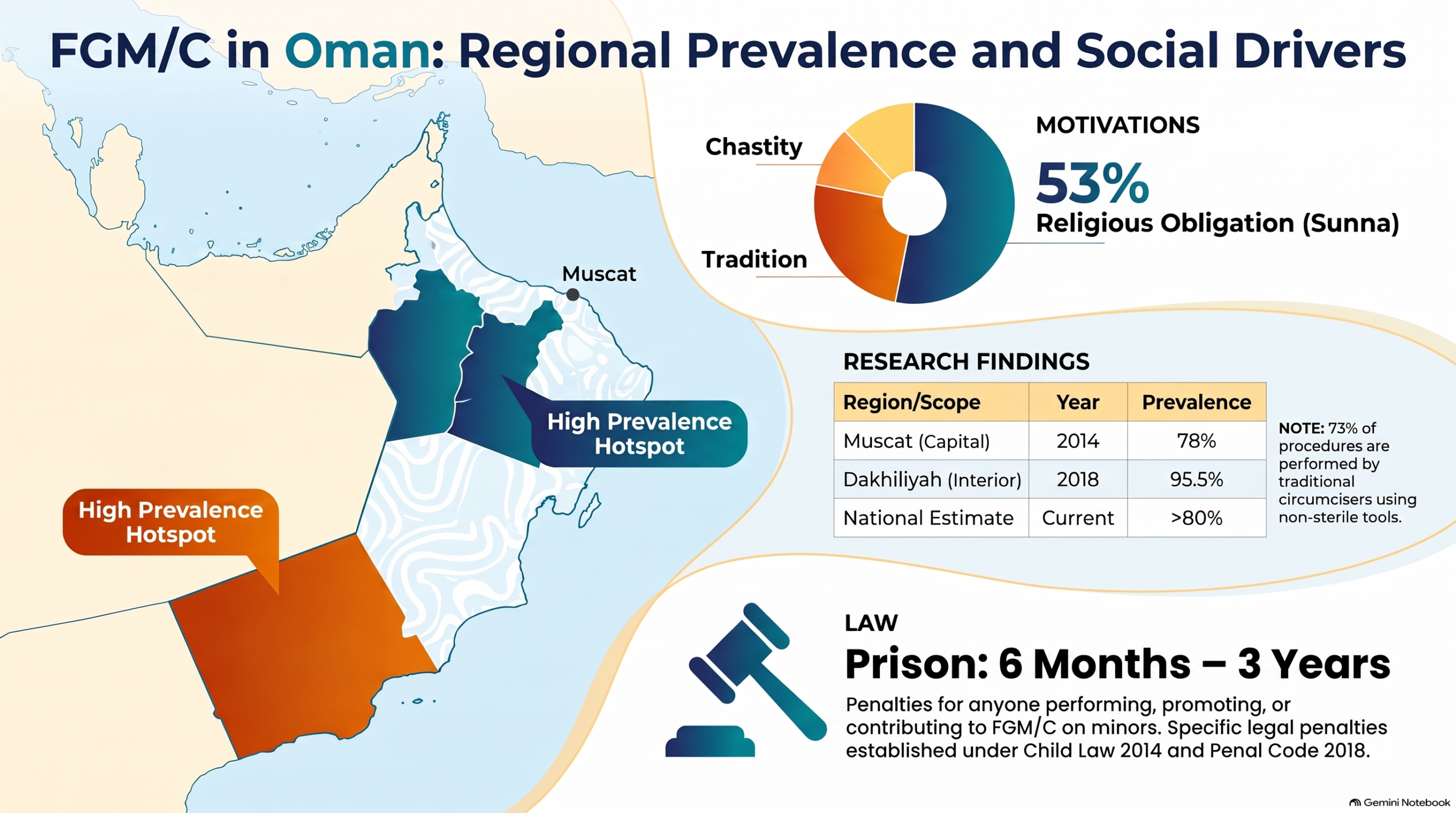
A study in 2014 by Habiba Al Hinai found 78 percent of women living in the capital Muscat to be but – the majority of them originating from Northern governorates. A study in 2018 by Hoda Thabet and Azza Al Kharousi found 95,5 percent of women from the governorate of Dakhilya to have undergone FGM.
Earlier studies by the government support the assumption that more than 80 percent of Omani women may have undergone FGM. A study on attitudes of adolescence in 2006 showed that 80 percent of females support female circumcision. Another regional study showed that the percentage of circumcised Omani female children (less than 3 years) was 100 percent in some willayats (communities). Both of these studies were quoted in the ‘Five-Year Health Plan: 2006-2010’ which is not online anymore. All attempts to obtain more Information from the Ministry of Health remained futile.
Social Norms, Chastity and Religion
Social tradition and perceived religious obligation are the primary drivers of FGM in Oman. Approximately 53% of women surveyed believe the practice is supported by Islamic teaching, often referred to as “sunna” (recommended). It is widely viewed as a prerequisite for “purity and chastity” and a means to manage a woman’s sexual desire.
Societal and family pressure to conform remains immense. In some communities, the practice is considered “sacred,” and older female relatives often arrange the procedure—sometimes behind the father’s back, according to some reports even against his will. While support is high among older generations, a debate in the younger generation was initiated by bloggers following the Arab spring. One survey found that while 55% of women supported the practice, a small majority of men (53%) were opposed to its continuation.
Traditional circumcisers still dominate
A significant majority of FGM procedures in Oman (73%) are still performed at home by traditional circumcisers using unsterilized traditional tools. However, there is a growing trend toward medicalization. Although the practice was banned in state hospitals in 2005, anecdotal evidence and research suggest that health professionals in private clinics are increasingly performing these procedures. This shift is particularly noted among the younger generation, where parents seek what they perceive as “safer” medical environments to continue the tradition.
Judicial Framework: Specific laws prohibit FGM
Unlike some neighboring countries, Oman has enacted specific legislation that explicitly addresses FGM:
- Child Law (Royal Decree No. 22/2014) and Ministerial Decision 125/2019: These laws explicitly identify FGM as a harmful traditional practice. Article 67 of the Child Law imposes prison sentences of six months to three years for anyone who performs, promotes, or contributes to FGM on a minor under 18.
- Omani Penal Code (2018): Articles 306-309 regarding “Assault Against Human Safety” provide a legal basis for prosecuting FGM performed on adults.
- Medical Liability: Article 44(b) of the Penal Code stipulates that medical professionals are only exempt from criminal liability if an act follows agreed scientific principles; since FGM has no medical benefit, practitioners cannot claim this exemption.
Despite these clear legal provisions, there have been no recorded criminal prosecutions for FGM in Oman to date. International bodies, such as the UN Committee on the Elimination of Discrimination Against Women (CEDAW), continue to urge the Omani government to move beyond “ink on paper” by enforcing these laws and undertaking comprehensive public awareness campaigns, particularly in rural areas.
Civil Society and Government Action
Activism on FGM remains largely muted in Oman due to restrictive laws governing non-governmental organizations and limited academic freedom. While the government has officially criminalized the practice, its stance is often seen as ambivalent, with a lack of coordinated national strategies or educational programs to dismantle the deep-rooted cultural attitudes that perpetuate the practice. The government of Oman is taking an ambivalent stand. Hospitals have been banned to carry out the operation, but private clinics offer it and traditional circumcisers promote their services on the premises of state hospitals. In 2005, the Health Ministry announced to study the prevalence of FGM in Oman and design programs for community awareness. However, no further efforts have been made and activism on the topic is muted.
Field Trip to Oman November/December 2013:
In Oman more than 80% of women could be mutilated – Results of a two-week field trip
Oman: Precise descriptions of FGM already in the 1960s
FGM is acknowledged but everyone is afraid to tackle it
Further Reading:
New Study: Almost 100 percent of women mutilated in region of Oman, August 2018
Habiba Al Hinai | Female Genital Mutilation in the Sultanate of Oman, January 2014
Y.A. Jasser et. al.: Knowledge, Attitudes and practices of secondary-school pupils in Oman: II. Reproductive Health, La Revue de Santé de la Mediteranée Orientale, Vol. 12, No. 1/2, 2006
Susan Al Shahri: Female Genital Mutilation in Dhofar: The Woman With the Frankincense Burner, June 7, 2011