
For long female genital mutilation (FGM) in Saudi Arabia was believed to be practiced by migrants only, confined primarily to communities from neighboring Yemen, Egypt and East Africa. However, recent research has revealed that FGM is practiced among native Saudi populations, particularly in the western (Hejaz) and southern (Asir) regions.
While there is some awareness in urban centers of its harmfulness, the lack of a specific law criminalizing the practice and permissive religious rulings ensure its continuation. Furthermore, a shift towards medicalization shields it from judicial and public scrutiny.
Prevalence: Mostly on Western Coast and in South
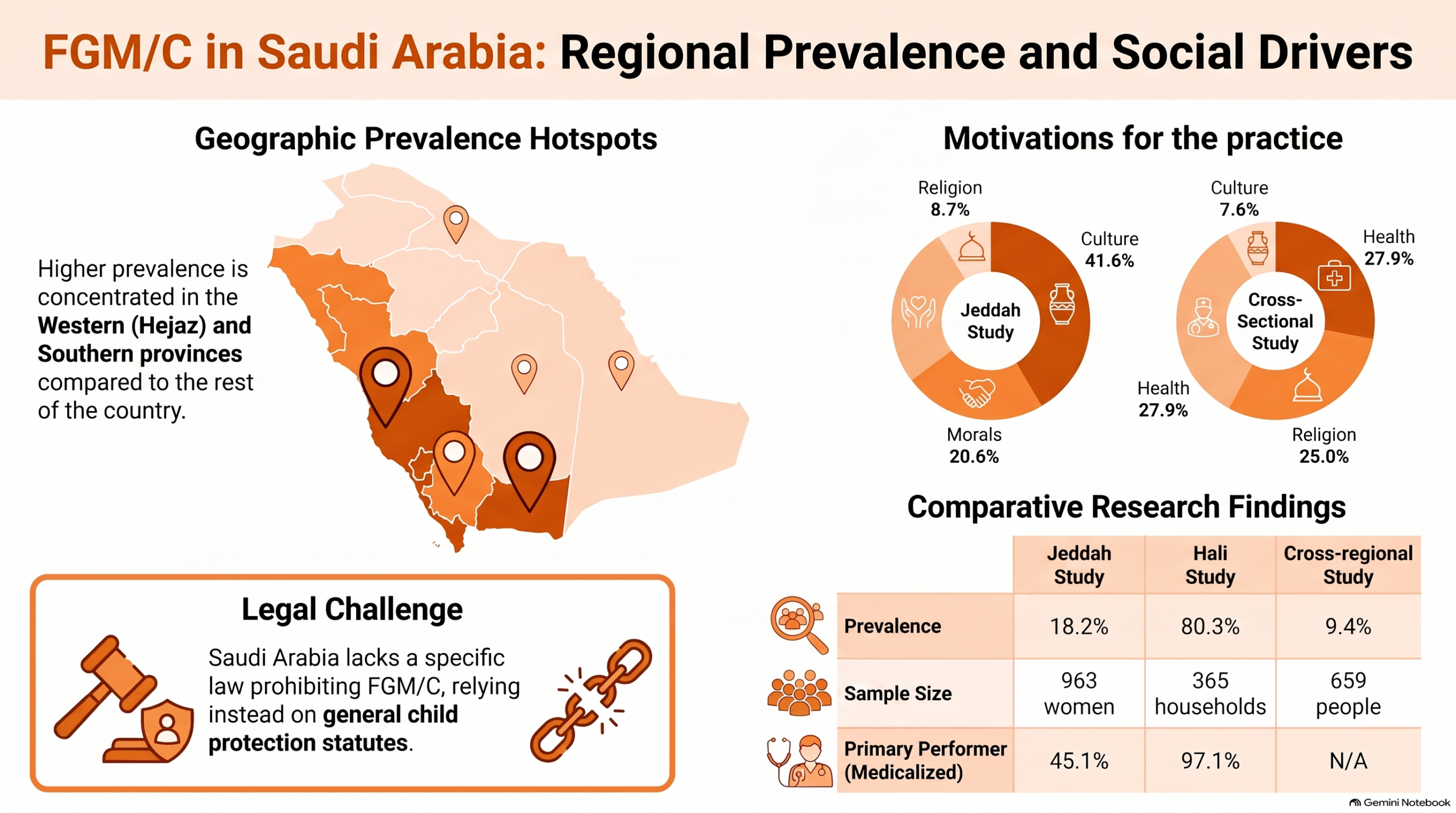
There are currently no nationwide statistics on the extent of FGM across Saudi Arabia. A cross-sectional study found a prevalence of 9.4% prevalence.[1] Localized surveys and hospital-based studies indicate extreme regional variations in prevalence. While a study of a Jeddah Hospital found a prevalence of 18.2%[2], a house hold survey in the Hali region in the Al-Qunfudhah Governorate on the western coast documented a prevalence rate of 80.3% among girls aged 18 and younger.[3] It needs to be noted that in the Jedda study native Saudis and naturalized Saudis accounted for 62.8% of FGM cases, while in Al-Qunfudhah 99% were of Saudi origin.
Demographic data show that women who have undergone FGM are often older, married, and from lower-income backgrounds. The study in Al-Qunfudhah also found a correlation with consanguinity in the family.
Culture, Religion or wrong believes about Health?
Main motivation for those who said they were in favor of the practice vary. In the Jeddah study most saw “culture and tradition” (41.6%), morals (20.6%) and religious beliefs (8.7%) as main reasons. In the cross-regional study, most often mentioned as a reason were health issues (27,9%), religion (25%) with culture being the least important (7,6%).
Yet, the larger number of women wants the practice to stop. In the Jeddah study, 68.7% were opposed to it while only 5,3% were in favor, in the cross-regional study 89,7% wanted it to stop and 10,3 % wanted it to continue.
Intra-familial decision-making is overwhelmingly driven by female relatives; in Jeddah, mothers (50.9%) and grandmothers (22.9%) were the primary decision-makers, while fathers accounted for only 4% of the direct decisions.
The degree of medicalization is generally high, varying from place to place. The Jeddah study found that procedures were mostly carried out at home with 56.6%, yet 21.7% of these by a nurse or physician. Another 23.4% took place in a hospital, adding up to roughly half being under the supervision of a medical professional. In the Al Qunfudhah study this rate was significantly higher with 91.4% carried out by a doctor and 5.7% by a nurse.
Legal Context: Arbitrary Enforcement of Child Protection
Saudi Arabia lacks a specific, codified statutory law that explicitly prohibits FGM. The legal response relies on a combination of general child protection statutes and the discretionary application of uncodified Sharia.
The 2014 Child Protection Law (Article 6) guarantees children protection against all forms of abuse and neglect. While “abuse” is defined as exposing a child to physical or psychological harm, FGM is not listed among the 14 recognized types of abuse in the legal text. Consequently, judicial intervention is rare, occurring only when a procedure results in a public scandal or life-threatening medical complications. A notable case occurred in Asir in 2020, where the Public Prosecution intervened after a young girl suffered severe trauma from a “primitive” home-based procedure.
Minor girls and dependent women generally cannot access legal representation or seek independent medical evaluations without the consent of their guardian.
Religious and Theological Dynamics
Religion plays a significant role in shaping social attitudes toward FGM in Saudi Arabia, and the theological landscape is marked by friction between different Sunni law schools.
- Jurisprudential Friction: The geographical distribution of FGM mirrors the influence of legal schools. The Shafi’i school, dominant in the western Hejaz and southern coastal plains, officially considers female circumcision obligatory (wajib). This accounts for the higher prevalence rates in these regions. The central Najd region, where the practice is less found, is dominated by the Hanbali school, which views it as a noble deed (makrumah) but explicitly states it is not obligatory.
- The Permanent Committee’s Stance: Saudi Arabia’s official religious apparatus, the Permanent Committee for Scientific Research and Ifta, has historically maintained a permissive stance, viewing female circumcision as “a natural practice, and commendable”. Former Grand Mufti Abdulaziz Bin Baz issued formal rulings describing it as “commendable” and a “custom” for preserving chastity.
In the past, there have also been attempts by religious scholar to spread the practice to parts of the country which are under the influence of the Hanbali school. The salafist Saudi preacher Sheikh Muhammad Salih al-Munajjid falsely claimed in a fatwa from 2005 which is still online that circumcision is obligatory for men and women also for the Hanbali.
[1] Mohammed Malak, Duaa Basalem et al: Awareness of Female Genital Mutilation/Cutting Among the General Population in 2019: A Survey-based Study in Saudi Arabia, 2020
[2] Rouzi AA, Berg RC, Alamoudi R, Alzaban F, Sehlo M. Survey on female genital mutilation/cutting in Jeddah, Saudi Arabia. BMJ Open. 2019
[3] Waleed Abdullah Milaat, Nahla Khamis Ibrahim, Hussain Mohammed Albar: Reproductive health profile and circumcision of females in the Hali semi-urban region, Saudi Arabia: A community-based cross-sectional survey, 2018
Further Reading:

[…] There is anecdotal evidence that FGC is practised. One study documented FGC amongst migrants and women born in Saudi Arabia. Sheikh Mohamad Alarefe, a popular Saudi Arabian Islamic theologian and professor, sent a tweet to 8 million followers stating “circumcision is a noble act to do to women” but later deleted it. […]
[…] [46] http://www.stopfgmmideast.org/countries/saudi-arabia/ […]