Home » Articles posted by hannahcaroline36 (Page 17)
Author Archives: hannahcaroline36
The Jordanian town that still circumcises women
The Daily Star, 13.11.2013. By Rana Sabbagh-Gargour
RAHMAH, Jordan: Tucked away in a valley bounded by steep ridges of mountains and stretching from the Red Sea port city of Aqaba to the escarpment of the Southern Ghor of the Dead Sea, is the town of Rahmah. From the outside, the nondescript ramshackle town of over 500 residents, whose Arabic name means “mercy,” appears little different from any other, with the exception of an ancient ritual performed there: that of circumcision, a practice otherwise unheard of in the conservative Hashemite Kingdom.
The tradition is believed to have been brought to Rahmah and other villages dotting the sand swept Wadi Araba region, by tribes and nomadic Bedouins who roamed across the boundary-less region decades ago, before they were forced to settle down in areas bordering Israel after the 1967 occupation of the Sinai Peninsula, the Negev desert and the Gaza Strip. Many of these clans, including the tribe living in Rahmah, trace their origins back to the Sinai Peninsula where the tradition of female genital mutilation (FGM) endures, despite a ban imposed on it by Egypt in 1997.
Religious leader claims ignorance is behind FGM in Iraq
Figo, 4.11. 2013. Female genital mutilation (FGM) in the Kurdistan region of Iraq has been described as a “practice that results from ignorance or religious fervency” by one of the area’s best-known religious commentators. Adnan Ibraham made the comments to Al-Monitor after a report released by UNICEF revealed the problem is still most rife in Kurdistan – where, in most cases, it is justified by perpetrators based on religious interpretations.
FGM was criminalised by the Iraqi government in 2011 following a protracted period of debate surrounding the decision that lasted six years. Since then, UNICEF has confirmed that recorded cases of FGM have almost halved, but the disproportionately high number of victims in Erbil, Sulaimaniyah and Kirkuk is a worrying prospect. Eight per cent of Iraqi women between the ages of 15 and 49 have been subjected to some form of the practice.
Mr Ibraham went on to dispel any links between FGM and Islam, saying: “There is no single piece of evidence in the Qur’an or sunna that legitimises or calls for [female] circumcision.”
Source
IRAQI KURDISTAN: WADI shifts attitudes toward Female Genital Mutilation
Christian Peacemakers, 4.11.2013.
by Rosemarie Milazzo
 |
|
| Falah Muradkhan addresses the media |
On 30 October 2013, CPT’s partner organization, WADI Iraq office, organized a press conference—which media representatives from six major Kurdish satellite channels and several newspapers attended —about the decline in Female Genital Mutilation (FGM) in Kurdistan. The WADI project coordinator, Falah Muradkhan said his organization had called the press conference because of the huge international attention stirred up on the topic caused by the recent BBC World and BBC Arabic’s airing of two documentaries and the reporting of the Guardian newspaper.
WADI used this occasion to present new data about the FGM situation in Kurdistan and WADI’s current activities. Two years ago, the Kurdistan Regional Government banned FGM as part of a wide-ranging law to improve women’s rights, after years of grassroots campaigning run by activist and civil society organizations, including WADI. In a region where honor killings still happen, journalists write about Kurdistan as a “rare success story.” Read full article
An amazing case of informed ignorance
29.10.2013. UNFPA und UNICEF just organized a high-level conference on female genital mutilation in Rome from October 21st to 25th. We took this as an opportunity to search for UNFPA statements on FGM in the Middle East and found this amazing piece in the Muscat Daily. In the article under the headline “FGM practiced in Oman; cases not ‘alarmingly’ high“, UNFPA representative of the sub-regional office for GCC-states, Asr Ahmed Toson, takes a wild guess: “Even though we have no data about Oman yet, I think FGM/C is not a serious issue compared to other countries and for that reason, it is not on our radar at this point of time. As an example, FGM/C is practiced much more in Egypt than in Oman.”
You can’t contest his facts. He is right: There is no reliable data about Oman, only a lot of evidence, some anecdotal, some quite profound – among them a Five-Year-Plan by the Ministry of Health which mentions the elimination of FGM as a target. Mr. Toson is most probably also right when pointing out that FGM is practiced much more in Egypt.
But you wonder how serious an issue must become to be on UNFPA’s radar. Egypt has one of the highest FGM rates in the world with 97 percent of women being cut. Since Oman is a multi-cultural society with people originating from India, Iran, Africa, Yemen and many Omanis having lived abroad, it would be very unlikely that all these different groups practice FGM. However, some do as Dr Nafissatou J Diop, coordinator of the joint UNFPA-UNICEF programme on FGM/C told the Muscat Daily. If these groups who practice FGM only make up 50 percent of the population in Oman would this not be alarming? (by Stop FGM Middle East)
How Kurdistan ended female genital mutilation
Gulf News 24.10.13. By Shaimaa Khalil
Toutkhal: Kurdistan is one of Iraq’s rare success stories; autonomous from Baghdad since 1991, the region has recently enjoyed an oil boom that’s fuelled foreign investment unknown elsewhere in the country.
And recently Iraqi Kurdistan has been looking closely at its human rights record. Two years ago Female Genital Mutilation was banned, as part of a wide-ranging law to improve women’s rights, and since then the rate of FGM has fallen dramatically.
But how have they achieved this? Kurdistan is very much the exception.
Many other countries in the Middle East and Africa still suffer from high rates of FGM. According to Unicef the countries where FGM is most prevalent is Somalia and Guinea, while Egypt is in the top five.
However according to Unicef the practice is ‘practically non-existent’ in the rest of Iraq. In a special report that is part of the BBC’s 100 Women Season, I found out more about the grass roots campaign that led to this practice being outlawed. I wanted to know if enough is being done to enforce the law, and end FGM in Kurdistan altogether.
One leg of my journey was to the sleepy village of Toutkhal — in a remote and mountainous area in Iraqi Kurdistan. At first glance, life seems untouched by the modern world. The small mud houses, surrounded by farm animals and people living off the land make it hard to imagine why this village would make the news.
FGM: BBC/ Guardian Film about the campaign to stop FGM in Iraqi-Kurdistan
 Today Guardian Films present a short version of a co-production with the BBC about the decade long fight against female genital mutilation (FGM) in Iraqi-Kurdistan. The BBC-Guardian team has followed two filmmakers who spend almost a decade reporting the greatest taboo subject in Kurdish society. Nabaz Ahmed and Shara Amin persuaded people to talk about the effects of FGM. Their film became an important tool in a capmpaign the grassroots organisation WADI launched to combat FGM and get the practice outlawed in 2011. Latest figures by WADI show that in some regions of Iraqi Kurdistan the number of girls being mutilated has fallen by over 60% in the last few years.
-
Film by Nabaz Ahmed, Shara Amin, Patrick Farrelly, Sinead Kinnane, Jordan Montminy, Maggie O’Kane and Alex Rees
- Length: 17min 06sec
- 2013
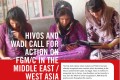
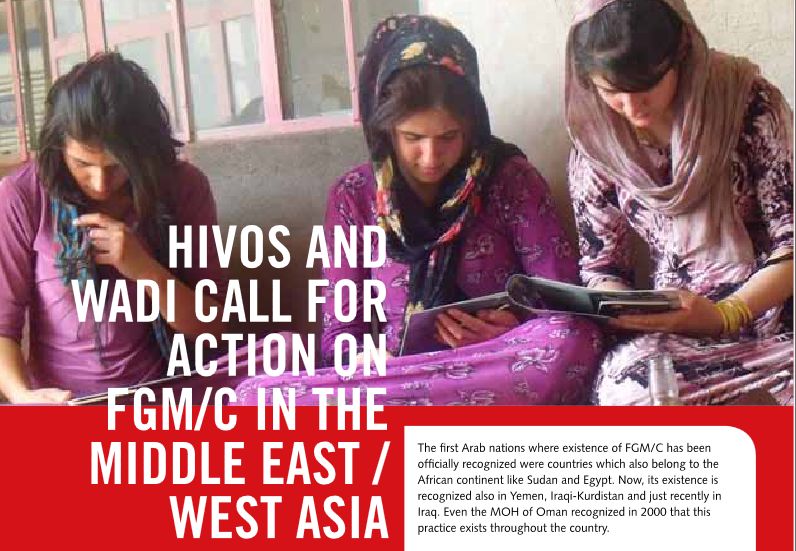
Hivos and Wadi Call for Action on FGM in the Middle East/ West Asia
For Download: Leaflet on FGM in the Middle East
Significant decrease of FGM in Iraqi-Kurdistan – new survey data
Kurdistan Tribune. 21.10.2013. In several Iraqi Kurdish regions female genital mutilation (FGM) has declined significantly within a decade.
During the last six months, the Iraqi-German NGO Wadi has collected data on the prevalence of female genital mutilation in the areas of Suleimaniyah, Halabja, Raniya, Goptata and Garmyan. Having discovered in 2004 that FGM was practiced widely, Wadi’s mobile teams developed a village-by-village approach in their campaign to raise awareness among women about the medical and psychological consequences of the practice.
The new data is based on interviews with 5,000 women and girls and indicates that this approach has led to a steep decrease in the practice. While 66 – 99% of women aged 25 and older were found to be mutilated, the percentage in the pertinent age group 6 – 10 was close to zero in Halabja and Garmyan. In both areas FGM was previously practiced widely and where the awareness campaign began first. In Suleimaniyah the rate of mutilation among 6-10 years old girls is at 11%, in Goptapa 21% and in Raniya – Wadi’s most recent operation area where the rate used to be close to 100% – has now dropped to 48%. The usual age for the cuttings is between 4 and 8 years in this region. Read more
New Publication by Unicef and Al Azhar
14.10.2013. UNICEF and Al-Azhar International Islamic Center for Population Studies released a book entitled FGM/C: Between the Incorrect Use of Science and the Misunderstood Doctrine, which is the second edition of a former publication from 2005, now reviewed by the Former President of Al Azhar University Dr. Ahmad Omar Hashim, the Former Minister of Waqfs Abdullah Al Hussaini Hilal and the Former-Grand Mufti of Egypt Ali Gomaa Mohamed.
The book explains the religious background of FGM in Islam and refutes the idea of female circumcision being Sunna. It points to the sexual and reproductive funtions of female external genitalia and the Islamic demand for sexual fullfillment for both sexes. It also discusses common misbeliefs such as the idea that a clitoris would grow as large as a man’s organ. The book is a usefull collection of arguments against FGM within an Islamic context. Yet, it errs when claiming that “within the Islamic World, FGM/C is practiced only in Egypt, Somalia, Sudan, Djibouti, and some parts of Yemen and Oman.” This leaves out a large number of countries where FGM is practiced such as Iraq, Iran, Malaysia, Indonesia and several African countries where Islam is the majority religion or the religion of a large minority.
Female Circumcision Widely Practiced in Malaysia
11.10.2013. Asia Calling reports from Malaysia where female genital mutilation is legal. In 2009 the countries highest Islamic body the Department for Islamic development has declared it mandatory.
And as Nabila Ali reports in June 2013 from KL recent surveys by the University of Malaya are showing practice is on the rise. Yet, not without critics. The organization Sisters in Islam are putting all their efforts into raising awareness about FGM.
[youtube=http://www.youtube.com/watch?v=OpVwOb7A2Ms&w=420&h=315]