The situation in the United Arab Emirates is quite similar to that of many Gulf countries. A seemingly modern and educated society exists next to and often within tribal structures. While the medical knowledge about female genital mutilation (FGM) being harmful is available to most, the subject is not talked about as anything connected to sexuality remains a taboo in this conservative society.
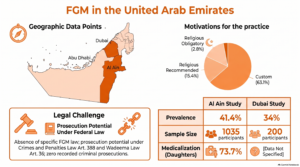
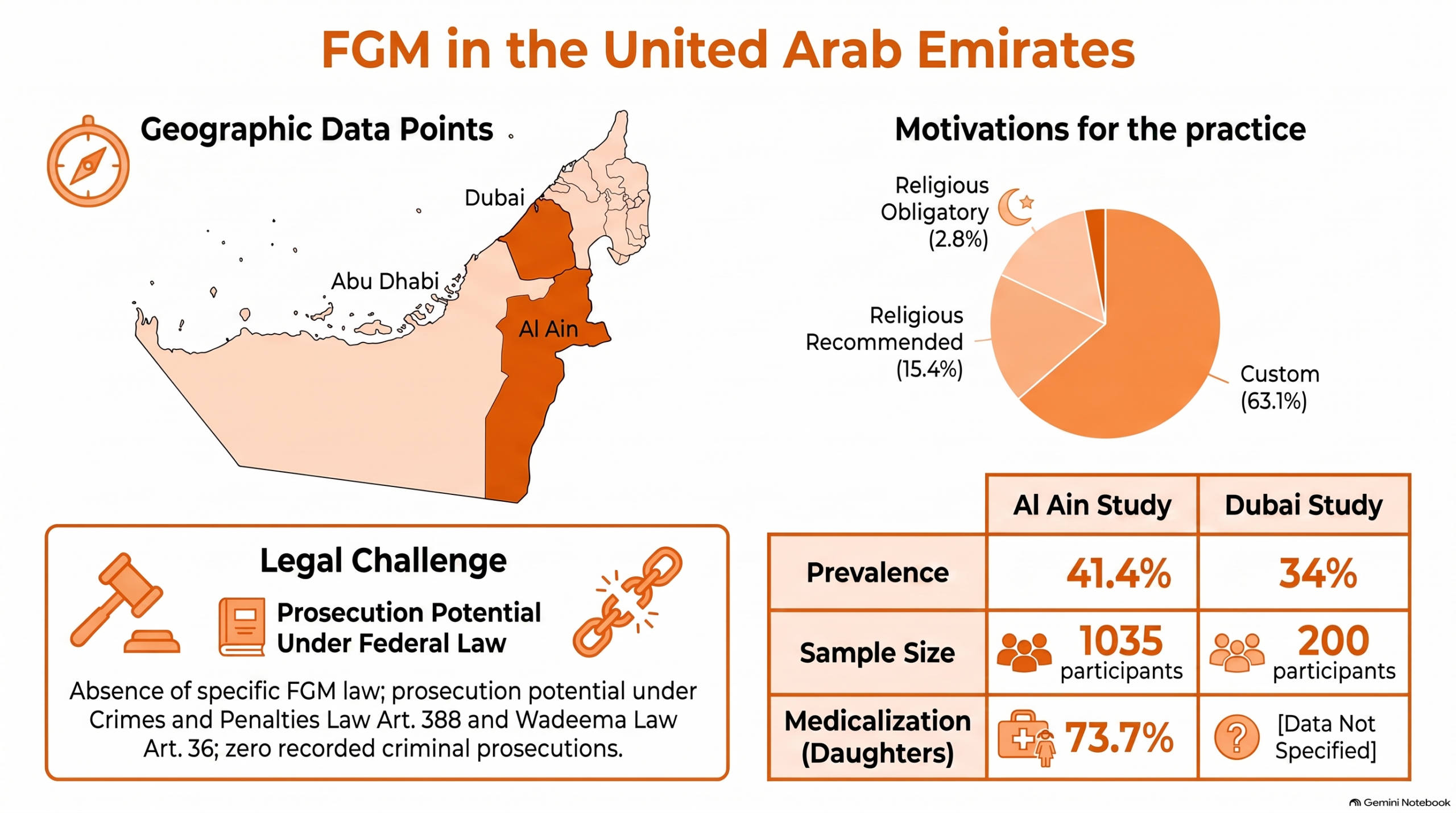
For long, there was no record of FGM in the United Arab Emirates (UAE). It was only in 2011, when a student from Dubai Women’s college decided to do a survey for her graduation project, questioning 100 women and 100 men, she found that 34% of the female respondents said they had undergone the practice.[1] Following this revelation, a more comprehensive cross-sectional study was conducted between 2016 and 2017 in Al Ain, the fourth largest city of the country, located at the border to Oman. It found a prevalence rate of 41.4% among the women surveyed.[2] Prevalence was found highest among UAE and GCC nationals (over 51%) compared to women from other non-African Arab countries (10.1%).
A majority of those 41,4% reported to have undergone FGM Type I (62.8%), 16,6% said Type II was done to them, Type III also known as infibulation was reported by 5% of respondents.
Data reveals a strong inverse association between FGM and levels of education and employment. Women with higher education and those who are employed are significantly less likely to have undergone FGM compared to illiterate, unemployed women or housewives.
Social norms, Marriageability and Religion
Social custom seems to be the primary driver of FGM in the UAE, with 69% of survey participants identifying it as such. Religion does play a relevant role though with 20.1% of survey respondents believing the practice is “sunna” (recommended), 5.5% view it as “fardh” (obligatory).
In some communities, it is viewed as a prerequisite for social acceptance; uncircumcised women face diminished marriage prospects. While in the small Dubai study only two men expressed that they would reject marrying an uncircumcised wife, the cross-sectional study found 21.6% of men still placing importance on marrying a circumcised woman, also expressing a desire to have their future daughters circumcised.
Low support for practice
On the other hand, support for the practice is generally low. The 2011 study found that 82 per cent of female and 99 per cent of male respondents opposed the practice, however, with 40% favoring it of those who had undergone the practice themselves. The later cross-sectional study found that the majority of all respondents (72.8%) were against it. Only 13.7% of the participants’ daughters had undergone the procedure, suggesting a generational shift toward abandonment of the practice.
Increasing Medicalization of FGM
A striking trend in the UAE is the increasing medicalization of FGM. While 74.4% of the older generation were cut by ritual or traditional circumcisers, the pattern has reversed for their daughters, 73.7% of whom were cut by medical professionals in private hospitals or clinics.[3] This shift is alarming to health authorities, as it suggests that the absence of specific criminal legislation may be prompting health professionals to perform these harmful procedures. A 2023 study of UAE medical practitioners found that while most were aware of the harms, 6.7% expressed a willingness to perform FGM if requested by a parent, and many were unaware of the legal implications.[4]
Judicial Framework
The UAE currently lacks a specific law that explicitly criminalizes FGM. However, the practice can be prosecuted under several broader federal laws:
Crimes and Penalties Law (Federal Decree Law No. 31 of 2021): Articles 387-394 relate to assault and the deliberate causing of permanent disability. Article 388 is particularly relevant, as it imposes up to seven years of imprisonment for causing a permanent disability, defined as the “cutting of, severance or amputation of an organ”.
Child Rights Law (Wadeema Law of 2016): This law protects children (under 18) from all forms of abuse and physical assault. Article 36 prohibits any act that compromises a child’s physical or emotional safety, with violations punishable by at least one year of imprisonment and substantial fines.
Medical Liability Law (2016): This law requires medical professionals to adhere to recognized scientific standards, which by definition exclude FGM as it has no medical benefits.
The practice is not allowed in government hospitals.
Despite these provisions, there have been no recorded criminal prosecutions for FGM in the UAE. International bodies, such as the UN Committee on the Elimination of Discrimination Against Women (CEDAW), have repeatedly urged the UAE to adopt specific legislation to criminalize the practice and systematically collect data to aid its eradication.
Civil society activism is generally stifled in the autocratically governed Emirates and the government has not undertaken any awareness raising themselves so far.
[2] Al Awar S, Al-Jefout M, Osman N, Balayah Z, Al Kindi N, Ucenic T. Prevalence, knowledge, attitude and practices of female genital mutilation and cutting (FGM/C) among United Arab Emirates population. BMC Womens Health. 2020
[4] Al Awar S, Zareba K, Sallam GS, Osman N, Ucenic T, Khair H, Shdefat SA, Fattah HA, Maki S. Legal Awareness and Practices of Female Genital Mutilation/Cutting (FGM/C) among United Arab Emirates Medical Practitioners. Int J Environ Res Public Health. 2023
We have a great task ahead of us. To combat FGM in the Middle East, we support local activists and researchers and lobby for Anti-FGM legislation. Please support us in our mission!